
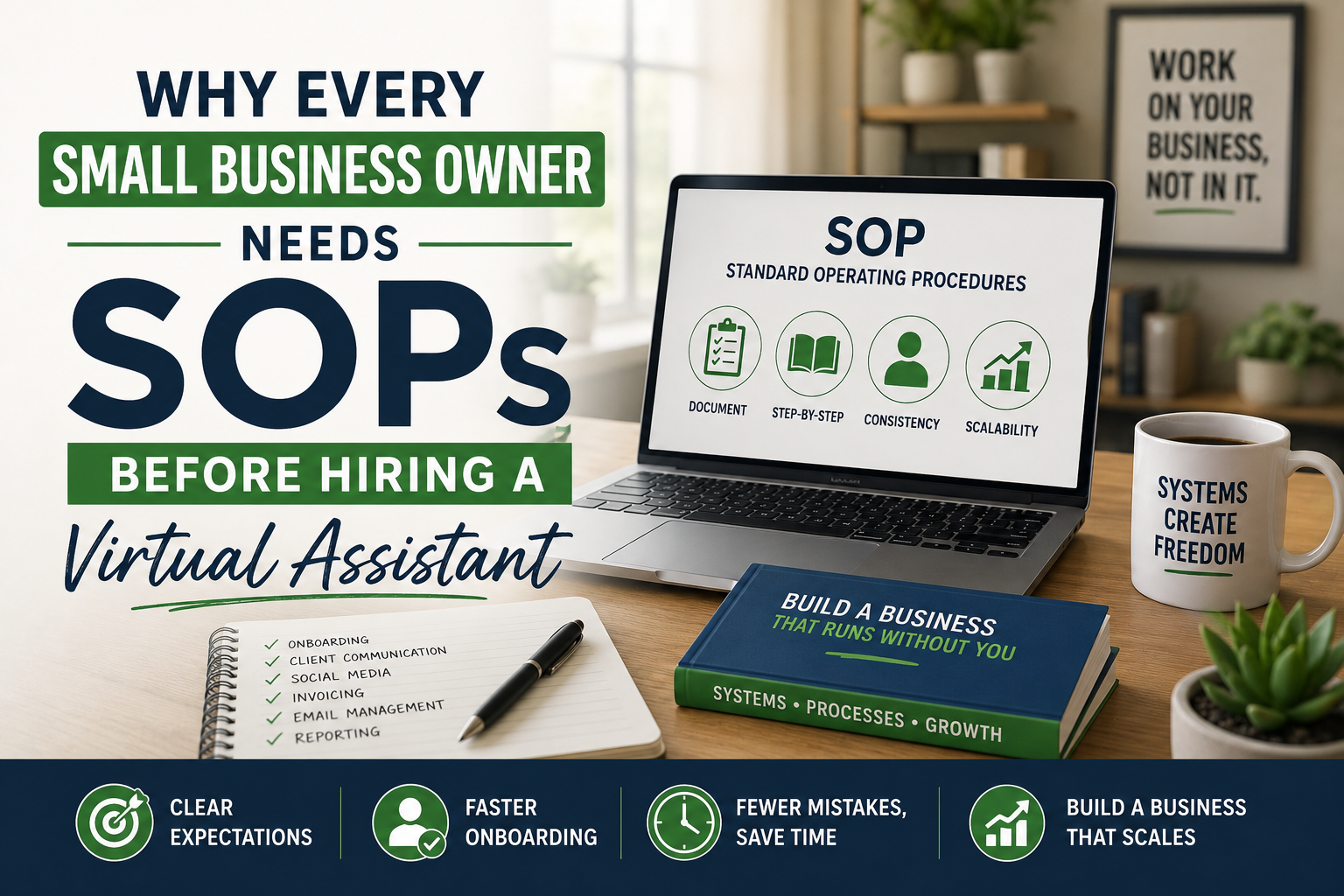
SOPs for real estate agents — standard operating procedures — are the single most important thing you can build before you hire a virtual assistant, and most agents skip this step entirely. They bring on a VA excited about finally getting their time back, and within 30 days they’re more frustrated than before: the work isn’t done right, the questions never stop, and the agent ends up doing most of the work themselves anyway. The problem isn’t the VA. It’s the absence of documented systems.
What SOPs for Real Estate Agents Actually Look Like
A standard operating procedure is a step-by-step document that explains exactly how a specific task gets done — who does it, when, using which tools, and what the finished result should look like. In a real estate business, SOPs cover everything from how leads get entered into your CRM to how listing photos get uploaded to the MLS to how past clients get touched every quarter.
Most real estate agents run entirely on instinct and institutional knowledge. They know how things should be done because they’ve been doing it themselves for years. But that knowledge lives in their head — not in any document a VA can actually reference. When you hire a VA and hand them a task without a written process, you’re asking them to guess at your standards. That guess will almost never match what you had in mind.
SOPs for real estate agents don’t need to be formal or elaborate. A short Loom video walking through a task, a numbered list in Google Docs, or a simple checklist in Notion — all of it works. What matters is that the process lives somewhere your VA can access it, follow it, and refer back to it without coming to you every time.
Why Most Real Estate VA Hires Fail Without SOPs
The pattern is consistent. An agent gets overwhelmed — they’re juggling showings, offers, client calls, and a mountain of administrative work — and they decide to hire a VA. Onboarding is rushed because there’s no time to slow down and train properly. Within a few weeks, the VA is either asking too many questions or making mistakes the agent has to clean up. The agent concludes the VA isn’t a good fit, moves on, and the cycle starts over.
This isn’t a people problem. It’s a systems problem. Without SOPs for real estate agents, the VA has no framework to operate inside. They’re improvising based on limited information, and their judgment won’t match yours because they don’t have your context, your history, or your standards — because you never wrote those things down.
When you build SOPs before you hire, the dynamic shifts completely. Your VA knows exactly what’s expected, how to do it, and what good looks like. Mistakes drop sharply. Questions become about edge cases rather than basics. And you stop being the bottleneck your VA constantly has to wait on.
The Most Important SOPs for Real Estate Agents to Build First
You don’t need to document your entire business before making your first hire. Focus on the tasks you plan to hand off first — the recurring, time-consuming work that follows a consistent pattern. Here’s where to start:
Lead Entry and CRM Management
Your CRM is the engine of your real estate business, and inconsistent data entry breaks the whole system. Your SOP should cover which fields get filled in for every lead, what source tags to apply, how to handle duplicates, and what triggers a follow-up task. When your VA has this documented, your database stays clean and your follow-up pipeline actually works.
Listing Coordination
Getting a listing live involves a surprising number of small steps: photo upload, MLS input, marketing copy, social assets, open house scheduling, and more. Without a checklist, things get missed and listings go live late or incomplete. Document every step of your listing launch workflow and your VA can own the entire process from the moment you sign the listing agreement.
Transaction Coordination
Once a property goes under contract, the coordination demands are relentless. Deadlines, document collection, lender updates, title communication, buyer check-ins — it’s a full-time job inside an already full-time job. A transaction coordination SOP gives your VA a complete checklist from contract to close so nothing falls through the cracks and you’re never the one chasing documents at the last minute.
Database Nurture and Past Client Follow-Up
Most agents know referrals and repeat business are their best source of revenue — and most agents also let their database go cold because they never get around to consistent outreach. A follow-up SOP defines exactly what touches happen, on what cadence, through which channels, and what your VA should say. With this documented, your relationships stay warm whether you’re slammed or not.
Inbox and Calendar Management
How should your VA sort, label, and prioritize your email? Which messages require a same-day response? Which senders always get priority? How should scheduling requests be handled? Without answers to these questions in writing, your VA will manage your inbox the way they would manage theirs — which won’t be the way you want it done.
How to Build SOPs for Real Estate Agents Without It Becoming a Project
The most common reason agents don’t have documented processes is time. There’s always something more urgent, and writing SOPs feels like a project you’ll get to eventually. Here’s the thing: you’re already doing every one of these tasks. The documentation doesn’t have to be a separate initiative — it can happen alongside your normal workflow.
The fastest approach is screen recording. Pull up Loom or any screen recorder, open the task, and narrate what you’re doing as you go. These videos become your first-draft SOPs instantly. Your VA can watch them during onboarding, and over time they can help you turn the recordings into written documents. Most tasks take less than 15 minutes to capture. The barrier isn’t time — it’s getting started.
If recording isn’t your preference, just write a rough numbered list. It doesn’t need to be polished or comprehensive. An SOP that covers 80% of the process is dramatically better than no SOP at all. You’ll refine it naturally as your VA encounters edge cases and asks questions — that feedback loop is how your documentation improves over time without requiring dedicated effort from you.
SOPs for Real Estate Agents Create a Business That Can Scale
There’s a bigger payoff to building SOPs that goes beyond your first VA hire. When your operations are documented, your business stops being dependent on you for everything. You can bring on a second VA without starting from scratch. You can hand tasks to a team member and know the standard will be maintained. You can take a week off without your pipeline stalling out.
The agents who scale their business past a certain point — the ones closing 50, 80, 100+ transactions a year — almost always have documented systems behind them. They didn’t build a bigger team and then figure out the processes. They built the processes and then the team followed naturally. SOPs for real estate agents are the foundation that makes every subsequent hire easier, cheaper, and more effective.
Your VA will also stay longer when they’re set up to succeed. Turnover in VA relationships is most often caused by unclear expectations and poor onboarding — both of which SOPs directly solve. A VA who feels confident in their role and knows exactly what’s expected of them performs better and stays. That stability compounds over time as they learn your business and get better at every task they own.
Already Have a VA and No SOPs? Here’s What to Do
If you’re already working with a VA and your processes are undocumented, don’t start over — start small. Identify the three tasks causing the most friction right now. Those are your first three SOPs. Document just those, share them with your VA, and watch the quality of work and the flow of communication shift immediately.
From there, build one SOP at a time. Every time your VA asks you how something should be done, that’s your signal: this needs to be documented. Answer the question and then write it down. Over 60 to 90 days, you’ll have a comprehensive operations library built almost entirely as a byproduct of your normal workflow — without ever sitting down to write documentation for its own sake.
How The Leverage Assist Company Sets You Up for Success
At The Leverage Assist Company, we place virtual assistants with real estate agents and small business owners — and we help you build the foundation that makes the hire actually work. That means helping you identify which tasks to delegate first, what your VA’s role should look like on day one, and how to create the SOPs for real estate agents that give your new hire a clear runway from the start.
We’ve been through this process with hundreds of agents. The ones who get the best results aren’t necessarily the most experienced at managing people — they’re the ones who took the time to document their processes before their VA started. We help you do exactly that, in a practical and efficient way, so your hire delivers results in weeks instead of months.
To learn more about how to prepare for your first VA hire, read our complete guide to hiring a virtual assistant. When you’re ready to take the next step, book a free Game Plan Call and we’ll map out exactly what your VA setup should look like — including which SOPs to build first.
Recent Virtual Assistant Articles
- The VA Playbook Webinar: Watch the Free Replay Now
- 5 Signs You’re Ready to Hire Your First Virtual Assistant
- How Real Estate Agents Use Virtual Assistants To Close More Deals
- The Complete Guide to Hiring a Virtual Assistant for Your Business
The Leverage Assist Company is a virtual assistant placement firm helping real estate agents and small business owners delegate smarter, scale faster, and reclaim their time. Learn more at leverageassist.co.