
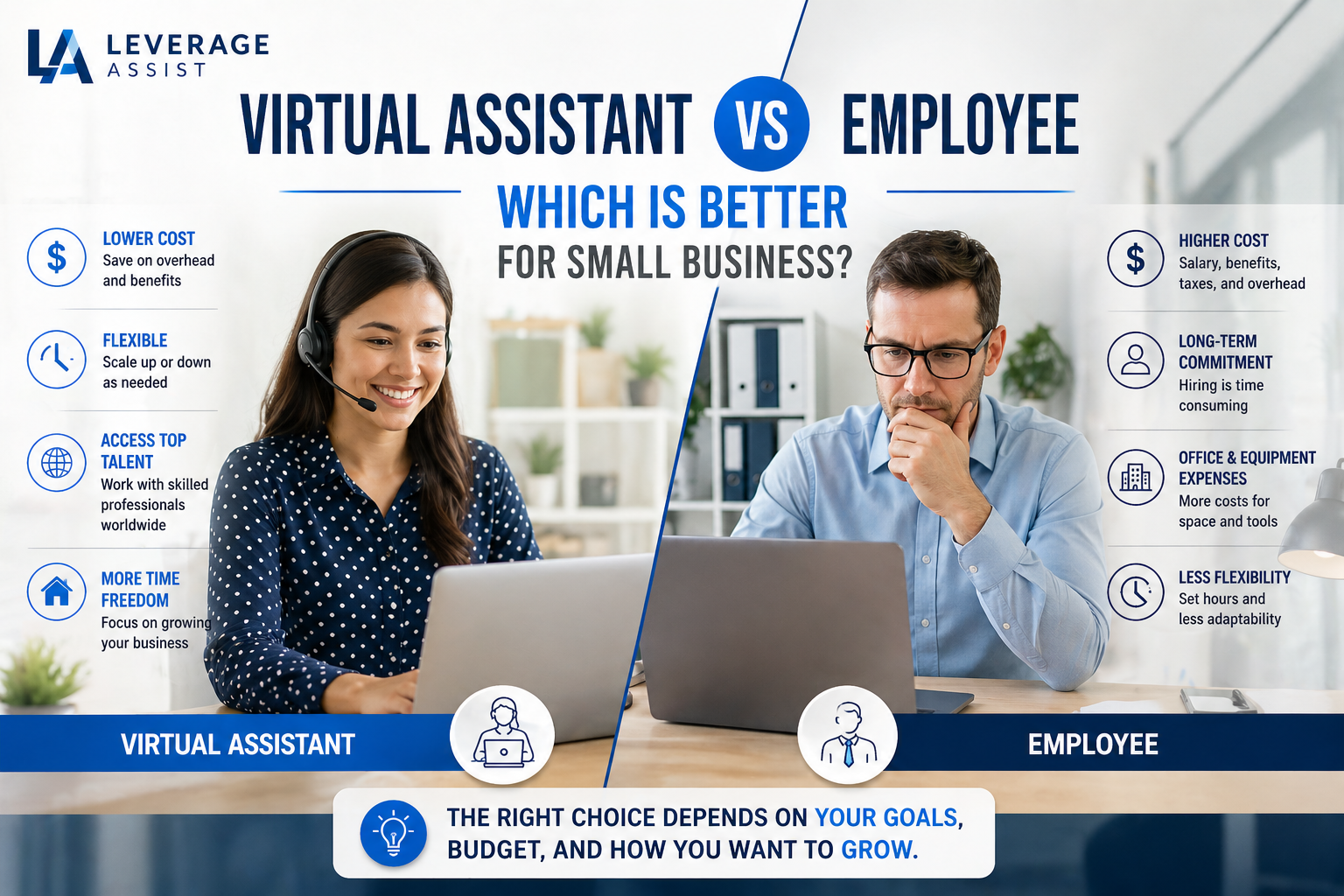
If you’re a small business owner trying to grow without burning out, you’ve probably asked yourself this question: should I hire a virtual assistant vs employee? It’s one of the most important decisions you’ll make as you scale — and the wrong choice can cost you thousands of dollars and months of wasted time.
In this guide, we’ll break down the real differences between bringing on a virtual assistant and hiring a traditional employee — covering costs, flexibility, risk, and what actually makes sense for where your business is right now.
What Is a Virtual Assistant?
A virtual assistant (VA) is a remote contractor who provides administrative, technical, or creative support to your business — typically on an hourly or project basis. VAs can handle everything from inbox management and scheduling to social media, customer service, research, and bookkeeping.
Unlike a traditional employee, a virtual assistant is not on your payroll. They work independently, often for multiple clients, and you engage them only for the hours or tasks you need.
Virtual Assistant vs Employee: The Core Differences
Before you make any hiring decision, it’s important to understand what you’re actually comparing. Here’s how a virtual assistant vs employee stacks up across the factors that matter most to small business owners:
1. Cost
This is usually the first place small business owners feel the difference.
Employees come with a full package of costs beyond their salary: payroll taxes (typically 7.65% employer-side FICA alone), workers’ compensation insurance, health benefits, paid time off, onboarding, equipment, and office space if applicable. When you factor everything in, the true cost of an employee is often 1.25–1.4x their base salary.
Virtual assistants are paid for the hours or deliverables you need — nothing more. No benefits, no payroll taxes, no equipment costs. You pay a flat rate or hourly fee, and that’s it. Depending on the VA’s location and skillset, rates can range from $8–$15/hour for overseas VAs to $25–$60/hour for specialized domestic VAs.
Winner: Virtual assistant — especially for early-stage businesses managing cash flow.
2. Flexibility
Business needs fluctuate. A launch month might require 40 hours of support. A slow quarter might require 8. Employees expect consistent hours and a stable role — and legally, you have obligations to maintain.
Virtual assistants offer genuine flexibility. You can scale hours up or down, bring them on for a single project, or pause engagement entirely during slow periods. That kind of elasticity is invaluable for small businesses operating in dynamic or seasonal markets.
Winner: Virtual assistant — built for the unpredictable nature of small business.
3. Commitment and Loyalty
Employees are invested in your business. They show up every day, build institutional knowledge, and often develop genuine loyalty over time. They’re also more likely to go above and beyond when they feel like part of a team with a long-term stake in outcomes.
Virtual assistants, on the other hand, are contractors who typically work with multiple clients. They’re professional and reliable, but they’re not embedded in your culture the same way. This isn’t a flaw — it’s just a different working relationship.
Winner: Employee — when long-term culture and deep ownership matter.
4. Legal and HR Complexity
Hiring an employee in the U.S. means navigating federal and state employment law: I-9 verification, W-4 forms, payroll compliance, anti-discrimination policies, potential FMLA obligations, termination protocols, and more. For a solo founder or small team, this complexity adds up fast.
Hiring a virtual assistant is dramatically simpler. Most VA engagements are governed by a basic service agreement and a 1099 at tax time (if they’re U.S.-based and earn over $600). No HR infrastructure required.
Winner: Virtual assistant — lower risk and simpler compliance for small teams.
5. Skill Specialization
Employees are hired for a defined role. If your needs evolve, retraining or rehiring is expensive and time-consuming.
With virtual assistants, you can access a global talent pool of specialists. Need a VA who’s expert in GoHighLevel? There’s one available. Need someone fluent in Shopify, Canva, or podcast editing? You can find them — often without paying the premium of a full-time specialist salary.
Winner: Virtual assistant — access to specialized skills on demand.
When a Virtual Assistant Makes More Sense
A virtual assistant is likely the right choice if:
- You need support but can’t yet justify a full-time salary
- Your workload is project-based or varies by season
- You need to offload repetitive tasks like email, scheduling, or data entry
- You’re testing whether a role is needed before committing to a hire
- You want to build systems and automation before adding headcount
- You’re a solopreneur trying to buy back your time without blowing your budget
At Leverage Assist, this is where we see the most transformative results. When entrepreneurs start delegating to a skilled VA — and pair that with the right systems and automations — they stop being the bottleneck in their own business.
When Hiring an Employee Makes More Sense
A traditional employee is likely the right choice if:
- You need someone physically present (retail, warehouse, in-person services)
- The role requires deep integration into proprietary systems or client-sensitive data
- You’re building a culture-driven team with long-term growth expectations
- The role demands consistent 40+ hours per week of dedicated work
- You’ve outgrown the flexibility model and need real organizational structure
There’s nothing wrong with hiring employees — but the mistake most small business owners make is hiring employees too early, before the systems and processes are in place to make that person genuinely productive.
The Real Question: Are You Ready to Delegate?
Whether you choose a virtual assistant vs employee, the bigger issue most small business owners face is this: they haven’t documented what they do well enough to hand it off to anyone.
Before you hire, you need systems. You need SOPs (standard operating procedures), clear task definitions, and ideally some level of automation handling the repetitive stuff that doesn’t need a human touch at all.
That’s the Leverage Assist approach. We help entrepreneurs build the operational foundation that makes every hire — VA or employee — dramatically more effective from day one.
Ready To Hire A Virtual Assistant? – Book A Free Game Plan Call here!
Virtual Assistant vs Employee: Quick Comparison Summary
| Factor | Virtual Assistant | Employee |
|---|---|---|
| Cost | Lower — pay for hours/tasks only | Higher — salary + benefits + taxes |
| Flexibility | High — scale up or down easily | Low — fixed schedule and commitment |
| Legal Complexity | Minimal | Significant |
| Specialization | Access global talent pool | Limited to local market |
| Culture Fit | Contractor relationship | Deep team integration |
| Best For | Lean, growing small businesses | Established teams with consistent volume |
Final Thoughts
The virtual assistant vs employee debate doesn’t have a universal answer — but for most small business owners who are still wearing too many hats, a virtual assistant is the faster, leaner, lower-risk path to getting real support without overextending your budget or your operations.
Start with a VA. Build your systems. Document your processes. Then, when the time comes to hire employees, you’ll have the infrastructure to make them immediately productive — rather than spending months figuring out what they should even be doing.
Ready to explore what delegation and automation could look like for your business? Let’s talk.
Recent Virtual Assistant Atricles:
The VA Playbook Webinar: From your First Hire To A Full Support Team
How Business Owners Use Virtual Assistants To Free Up 20+ Hours Per Week
The Complete Guide To Hiring A Virtual Assistant For Your Business