
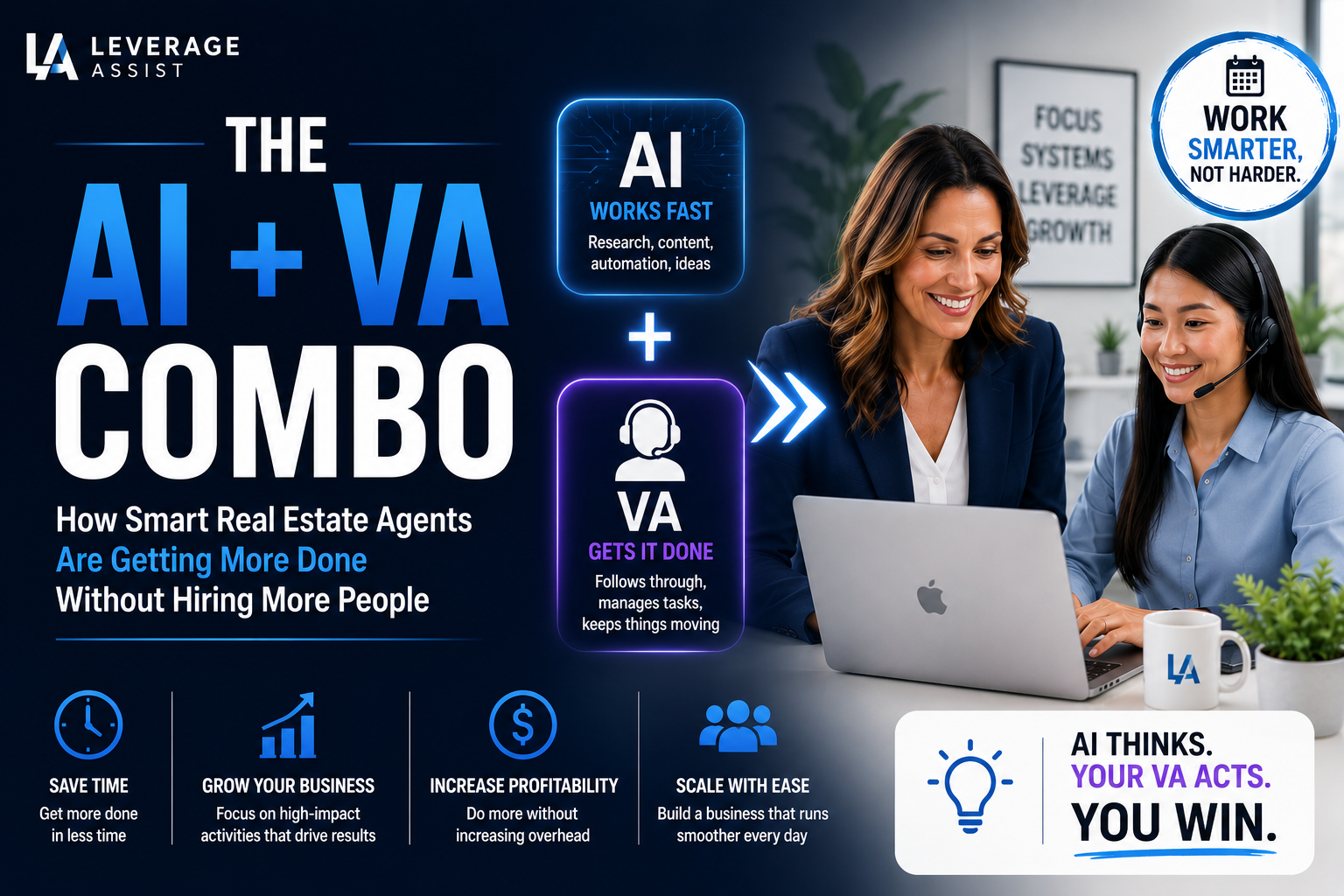
AI and virtual assistants for real estate agents are no longer two separate conversations — the most productive agents in 2026 are combining both into a single, high-output system that lets them do more than any solo operator or traditionally staffed team ever could. The result isn’t just efficiency. It’s a compounding advantage that gets wider every month as competitors who haven’t figured this out fall further behind.
What the AI and Virtual Assistants For Real Estate Agents Combo Looks Like
The misconception most agents have is that AI and virtual assistants compete with each other — that using one means you don’t need the other. That’s not how the best-performing teams are actually using these tools. AI handles the fast, repetitive, rule-based work that doesn’t require judgment or relationship. A VA handles everything that requires human presence, adaptive thinking, and the kind of nuanced communication that clients notice and respond to.
Think of it as a division of cognitive labor. AI drafts the email; your VA reviews it, personalizes the tone, and sends it. AI pulls the comps and generates a summary; your VA formats it into the report you actually hand to a client. AI flags the leads that haven’t been touched in 30 days; your VA makes the calls. Neither tool is doing the full job. Together, they’re doing a job that would take two or three people if you were doing it the old way.
Where AI Helps Real Estate Agents (And Where It Falls Short)
AI tools have genuinely transformed the speed at which certain tasks get done in a real estate business. Content drafting, data analysis, market summaries, email templates, social media captions, CRM note formatting — all of it can be generated in seconds now. For an agent who used to spend an hour writing a just-listed email, that’s an hour back in their day. Every single day.
But AI has a ceiling that most agents bump into quickly. It doesn’t know your clients. It doesn’t know that this particular buyer has called three times this week and needs a human touch, not another automated message. It can’t pick up on the tone shift in a seller’s email that signals they’re getting cold feet. It can’t build rapport, handle objections in real time, or make judgment calls about how to respond to a difficult situation at 9pm on a Sunday. It hallucinates details, misreads context, and produces outputs that require human review before anything goes out the door.
AI is a powerful first-pass tool. It is not a relationship tool. And real estate is fundamentally a relationship business.
What Virtual Assistants Do That AI Cannot
A great VA brings something AI simply cannot replicate: consistent human judgment applied to your specific business over time. A VA learns how you communicate, what you care about, what your clients expect, and how you like things done. That institutional knowledge compounds. Three months in, your VA isn’t just executing tasks — they’re anticipating needs, catching problems before they reach you, and operating your business the way you would if you had unlimited time.
Virtual assistants also handle the coordination work that AI can’t touch — scheduling calls, following up on missing documents, managing vendor relationships, keeping your transaction checklist moving, and staying on top of client communication threads that span weeks. These are the tasks where a dropped ball costs you money or damages a relationship. They require someone who is accountable, responsive, and genuinely invested in your success.
And critically, a VA can use AI tools themselves. The best VAs in 2026 are already using AI to work faster — drafting content in half the time, summarizing long email threads before responding, generating social media options for you to choose from. When your VA is AI-enabled, the output from that one hire multiplies significantly.
How Smart Agents Are Dividing Work Between AI and Their VA
The most effective AI + VA systems aren’t complicated. They follow a simple principle: AI handles the draft, the data, and the detection. The VA handles the delivery, the decisions, and the relationships. Here’s how that plays out across the most common real estate workflows:
Lead Follow-Up
AI identifies which leads in your CRM haven’t been contacted recently and generates a suggested follow-up message based on their last interaction. Your VA reviews the message, personalizes it based on context, and sends it — or makes a call instead if the lead warrants a personal touch. Response rates go up. No leads fall through the cracks. The agent never has to think about it.
Listing Marketing
AI generates multiple versions of the listing description, social media captions, and email copy. Your VA selects the best version, edits for accuracy and brand voice, uploads everything to the right platforms, and schedules the posts. What used to take two to three hours of agent time now takes 20 minutes of VA time — and most of that is just reviewing AI output.
Client Communication
AI drafts responses to routine inbox messages — update requests, showing confirmations, document acknowledgments. Your VA reviews, adjusts the tone where needed, and handles anything that requires genuine judgment or sensitive handling. Your clients get fast, personalized responses. Your inbox stays under control without you ever touching it.
Market Reports and Buyer Prep
AI pulls current market data and generates a draft summary. Your VA formats it into your standard report template, adds the charts, and sends it to the client with a personalized note. The agent reviews the final version in under five minutes and approves. The client gets a polished, professional deliverable. No one spent two hours building a report from scratch.
Building Your AI + VA System Without Overcomplicating It
The biggest mistake agents make when trying to implement AI tools is trying to automate everything at once. They spend weeks setting up complex workflows that don’t actually match how their business runs, get frustrated when things break, and abandon the whole initiative. The better approach is to start with one workflow, get it running smoothly, and then expand from there.
Pick the task that’s costing you the most time right now. If it’s lead follow-up, start there. Set up a simple AI-assisted follow-up process and hand the execution to your VA. Run it for 30 days. Refine what’s not working. Then add the next workflow. In 90 days you’ll have a real system — not a theoretical one.
The VA is the glue in this setup. AI tools don’t run themselves. They produce output that needs to be reviewed, edited, organized, and deployed. A VA who understands your business and knows how to use AI tools is the person who makes the whole system actually function. Without that human layer, AI in a real estate business tends to become a novelty that gets used inconsistently and then quietly abandoned.
Why Real Estate Agents Using AI and Virtual Assistants Are Pulling Ahead
The agents who have built AI and VA systems aren’t just saving time — they’re compressing what used to take a team of four into what one well-supported agent can do. They’re following up faster than competitors. They’re producing better marketing. They’re staying more consistently in front of their database. They’re closing more transactions without working more hours.
And because the system improves over time — the VA gets better, the AI prompts get sharper, the workflows get more refined — the advantage compounds. An agent who builds this system in 2026 will be dramatically more productive in 2027 than an agent who waits. The gap between those who figure this out and those who don’t is only going to grow.
The good news is you don’t have to figure it all out yourself. The Leverage Assist Company places experienced VAs who are already familiar with AI tools, real estate workflows, and the kind of systems that actually hold up in a busy agent’s business. We help you match the right VA to the right role and build the foundation that makes the AI + VA combo actually work. To learn more, read our complete guide to hiring a virtual assistant — or book a Game Plan Call and let’s map out your setup together.
Recent Virtual Assistant Articles
- Why Real Estate Agents Are Hiring Virtual Assistants in 2026 (And What’s Finally Changed)
- Build Once, Delegate Forever: The SOP Framework for Virtual Assistants Success
- Why Real Estate Agents Need SOPs Before Hiring a Virtual Assistant
- The Complete Guide to Hiring a Virtual Assistant for Your Business
Watch The VA Playbook Webinar On Demand Here!
The Leverage Assist Company is a virtual assistant placement firm helping real estate agents and small business owners delegate smarter, scale faster, and reclaim their time. Learn more at leverageassist.co.